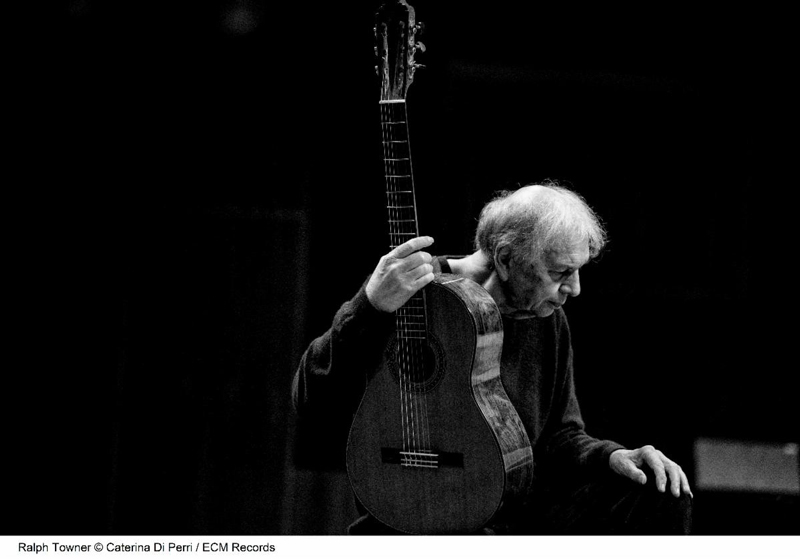
(headline image: Ralph Towner – Photo by Caterina Di Perri-ECM)
Ralph Towner, a renowned American guitarist, pianist, composer, and longtime ECM recording artist, died on January 18, 2026, in Rome, Italy. He was 85.
Towner was born on March 1, 1940, in Chehalis, Washington, into a musical family. He began playing music at the age of six and became a young multi-instrumentalist, performing on trumpet, french horn, and piano. He did not take up classical guitar until his early twenties, when he moved to Vienna to study with Karl Scheit. There he immersed himself in western classical repertoire, including transcriptions of renaissance lute music, and devoted long hours to disciplined practice.
After returning to the United States, Towner broadened his musical language. In the early to mid-1960s, he was strongly influenced by Brazilian music while earning his living as a jazz pianist. At the same time, the Bill Evans Trio with Scott LaFaro and Paul Motian provided a model for the kind of interactive, chamber-like approach he sought to realize on guitar. He later described his method as weaving together three principal lines: Brazilian music, Evans’s conception of jazz, and classical guitar, which he gradually abstracted and modified into a personal idiom.
Towner joined Paul Winter’s Consort in the late 1960s, participating in an ensemble often cited as a pioneering force in world music.
In 1970, he left the group with colleagues Paul McCandless, Glen Moore, and Collin Walcott to form influential band Oregon. Throughout the 1970s, Oregon developed an influential approach that combined folk elements, Indian classical forms, and avant-garde, jazz-based free improvisation. The group’s work was documented on numerous albums, including the ECM releases Trios/Solos (1972), Oregon (1983), and Crossing (1984).
Many listeners first heard Towner on Weather Report’s 1972 album I Sing The Body Electric, where his free, 12-string guitar introduction to Wayne Shorter’s “The Moors” drew wide attention. Around the same period he met ECM founder Manfred Eicher in New York, an introduction facilitated by bassist Dave Holland. That meeting led to a creative partnership with ECM that lasted for more than fifty years.
Towner’s early ECM recordings included a series of notable solo and ensemble projects. The solo albums Diary (recorded 1973) and Solo Concert (1979) presented his unaccompanied guitar and piano work. Solstice (1974), which featured Towner with Jan Garbarek, Eberhard Weber, and Jon Christensen, became recognized as a key document of modern European jazz. The duet album Matchbook (1974), with vibraphonist Gary Burton, included a version of “Goodbye Pork Pie Hat” that Charles Mingus cited as his favorite.
Collaborations were essential during his long career. Towner’s duo work with guitarist John Abercrombie produced Sargasso Sea (1976) and Five Years Later and included appearances together on Kenny Wheeler’s Deer Wan. His album Batik (1979), with Jack DeJohnette and Eddie Gomez, opened with the frequently noted composition “Waterwheel.” He contributed to Keith Jarrett’s In The Light (1973), performing “Short Piece for Guitar and Strings,” and helped define the sound of Jan Garbarek’s Dis (1976), where his guitar appears alongside the distinctive drone of a windharp. A guest role on Egberto Gismonti’s Sol Do Meio Dia (1977) brought him into direct dialogue with Brazilian music again.
Towner’s own Old Friends, New Friends (1979) featured trumpeter Kenny Wheeler, who later invited Towner into the Azimuth recording Départ with John Taylor and Norma Winstone. Winstone would go on to write lyrics for several Towner compositions, recording them on albums including Somewhere Called Home, Dance Without Answer, and Outpost of Dreams (2024), which features his piece “Beneath an Evening Sky.”
Work with Oregon continued in parallel with his solo and leader dates. The group’s 1980s recordings, and Towner’s multi-instrumental, multitracked solo album Blue Sun (1984), documented periods in which he occasionally expanded his instrumental palette with electronic keyboards, including a Prophet-5 synthesizer. That instrument also appeared on the duo album Open Letter with drummer Peter Erskine. Even as he explored electronic color, his projects often emphasized close acoustic interplay, notably in collaborations with bassists Marc Johnson, Gary Peacock, and Arild Andersen. Albums such as Lost and Found (with Johnson), Oracle and A Closer View (duos with Peacock), and Andersen’s If You Look Far Enough kept the focus on intimate ensemble interaction.
By the 1990s, Towner had settled in Southern Europe. He married Italian actress Mariella Lo Sardo and lived first in Palermo, Sicily, and later in Rome. New partnerships emerged during this period, including a duo with Sardinian trumpeter Paolo Fresu on Chiaroscuro (2008) and a guitar trio with Wolfgang Muthspiel and Slava Grigoryan on Travel Guide (2012).
A substantial part of Towner’s later discography consists of solo guitar albums that he described as strongly autobiographical. ANA and Anthem were recorded at Rainbow Studio in Oslo in 1996 and 2000, followed by Time Line at Sankt Gerold in 2005, and My Foolish Heart and At First Light in Lugano in 2016 and 2022. On At First Light he returned to some of his early inspirations, writing pieces that, in his words, incorporated “trace elements” of musicians and composers who had attracted him over the years, including George Gershwin, John Coltrane, John Dowland, and Bill Evans.
Towner often reflected publicly on his approach to improvisation and form. He once compared music to literature, suggesting that it “unfolds to the listener as does a work of literature, only without the specific meanings of written or spoken words,” and noted that an improvising soloist remains free to redirect the course of a piece whenever the “story” seems to require a turn.
Over more than six decades of activity, Ralph Towner developed a distinct voice on classical and 12-string guitar, integrating elements of jazz, classical, Brazilian music, and world music into a body of work that crossed stylistic and geographic boundaries. His superb recordings with Oregon, his extensive ECM catalog, and his solo performances continue to be heard internationally by audiences across multiple traditions.