
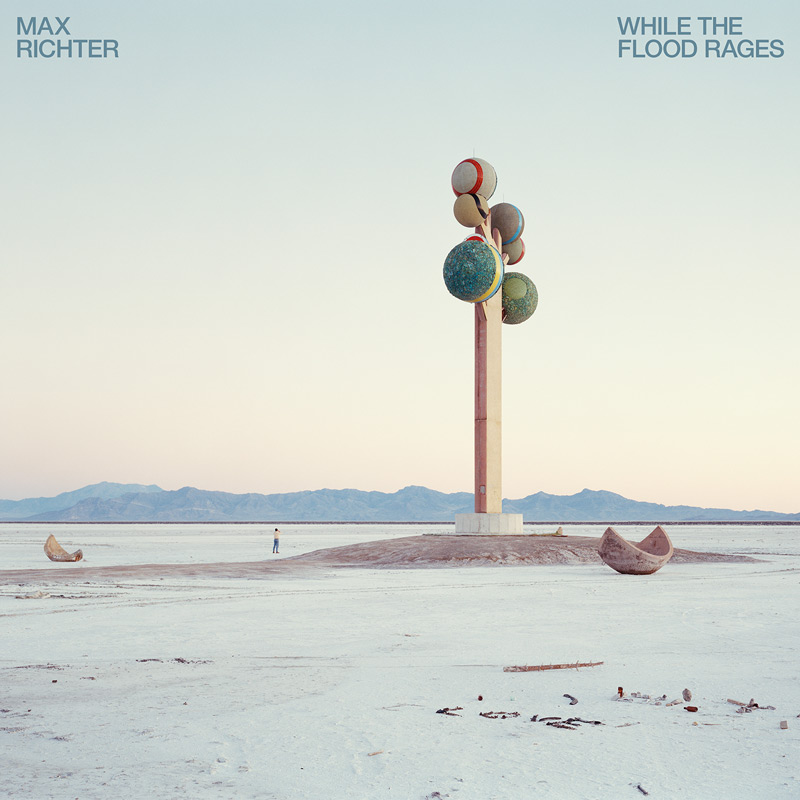
Max Richter – While the Flood Rages (Decca, 2026)
While the Flood Rages, Max Richter’s ambitious and impressive new album, stemmed from MaddAddam, his latest collaboration with choreographer Wayne McGregor. A co-commission by the National Ballet of Canada and the Royal Opera House, the ballet takes its inspiration from Margaret Atwood’s dystopian MaddAddam trilogy. The books describe unsettling visions of ecological collapse, technological excess, and humanity’s precarious future.
This project is Richter and McGregor’s third major collaboration, following Infra and Woolf Works. It has endured an unusually long gestation. The project was conceived before the COVID-19 pandemic and was subsequently delayed. It is available now at a moment when Atwood’s warnings seem less speculative than they once did. Richter responds to these concerns with a work of considerable imagination.
Rather than reproduce the ballet’s score, Richter has reconstructed its material as an independent album. “I took the material apart and created a trajectory that makes sense just through listening,” he explains. “It’s a different way to reach the same destination.” The Flood Rages has its own dramatic logic, free from the choreography, yet closely connected to the ideas behind it.
Recorded at Studio Richter Mahr, the album includes 15 exquisite tracks arranged in three acts. The opening piece, “Wave After Wave,” transforms a processed ocean recording into a persistent, heartbeat-like pulse. Its physical immediacy establishes an uneasy relationship between natural forces and human vulnerability. “Eerie Music” follows with brittle electronic disturbances derived from electromagnetic recordings of technological equipment around the studio. These peculiar mechanical signals introduce an ingenious contradiction: the devices that define contemporary life also harbor strange, almost alien voices.
The title piece, “While the Flood Rages,” offers a more private perspective. Its restrained intimacy provides a poignant contrast to the surrounding turbulence, with human connection presented as something fragile but essential. “The City Was a Chaos” piles dense, competing elements into an increasingly congested structure. It effectively represents a society overwhelmed by its own inventions. The subsequent “Quiet” offers welcome relief through a spare, descending piano figure. This modest musical idea becomes one of the album’s most persuasive features. It resurfaces in altered forms as circumstances grow more volatile.
The second act introduces sharper contrasts. “Tell the Bees” evokes a pastoral world through its gentle, folk-influenced character, with an appealing sense of intimacy. “Data Ballistics,” by comparison, is abrasive and confrontational, its percussive patterns assembled from manipulated gunfire.
Throughout the work, acoustic instruments, orchestral passages, and electronic interventions coexist in uneasy proximity. Richter is particularly adept at making these contrasting elements feel consequential.
In the third act, “Dawn” and “Background Radiation” bring choir, orchestra, and electronics into increasingly intricate relationships. Earlier ideas reappear in unfamiliar configurations, while the recurring piano figure undergoes further alterations.
The spellbinding closing piece, “Now We Can Sing,” also serves as the album’s first single. Inspired directly by Atwood’s writing, it develops the familiar piano figure into an expansive choral statement.
To accompany the release, Richter will host the WTFR Global Listening Events, an international series of intimate gatherings inspired by the listening-bar cultures of Tokyo, London, Seoul, Copenhagen, New York, and Melbourne. Cafés, wine bars, and hi-fi venues will become temporary listening rooms, where audiences can set aside their devices and experience the album without interruption.